How to control a conveyor belt using MODBUS-RTU
With MODBUS-RTU, you can control the movement of a conveyor belt from your robot or PC. This tutorial will show how to connect the conveyor belt to your PC and control it through your PC, but this is theoretically possible with the MODBUS port on a DOOSAN or Universal Robot control box.
What is MODBUS-RTU?
MODBUS-RTU is an industrial communication protocol to send data between systems. It uses an RS-485 interface to physically connect devices together.
If you want to know more, here are some useful links:
MODBUS-RTU
RS-485
What do you need?
I’ve tested this with one conveyor belt, so you’ll need the one in the picture below.
TODO: ADD PHOTO
- Conveyor belt with Mitsubishi Electric FR-D720S-025SC-EC inverter
- USB to RS-485 converter (I’ve used the following link)
- Ethernet cable you can cut
Physical setup
The inverter should already be wired so it has power and can drive the motor.
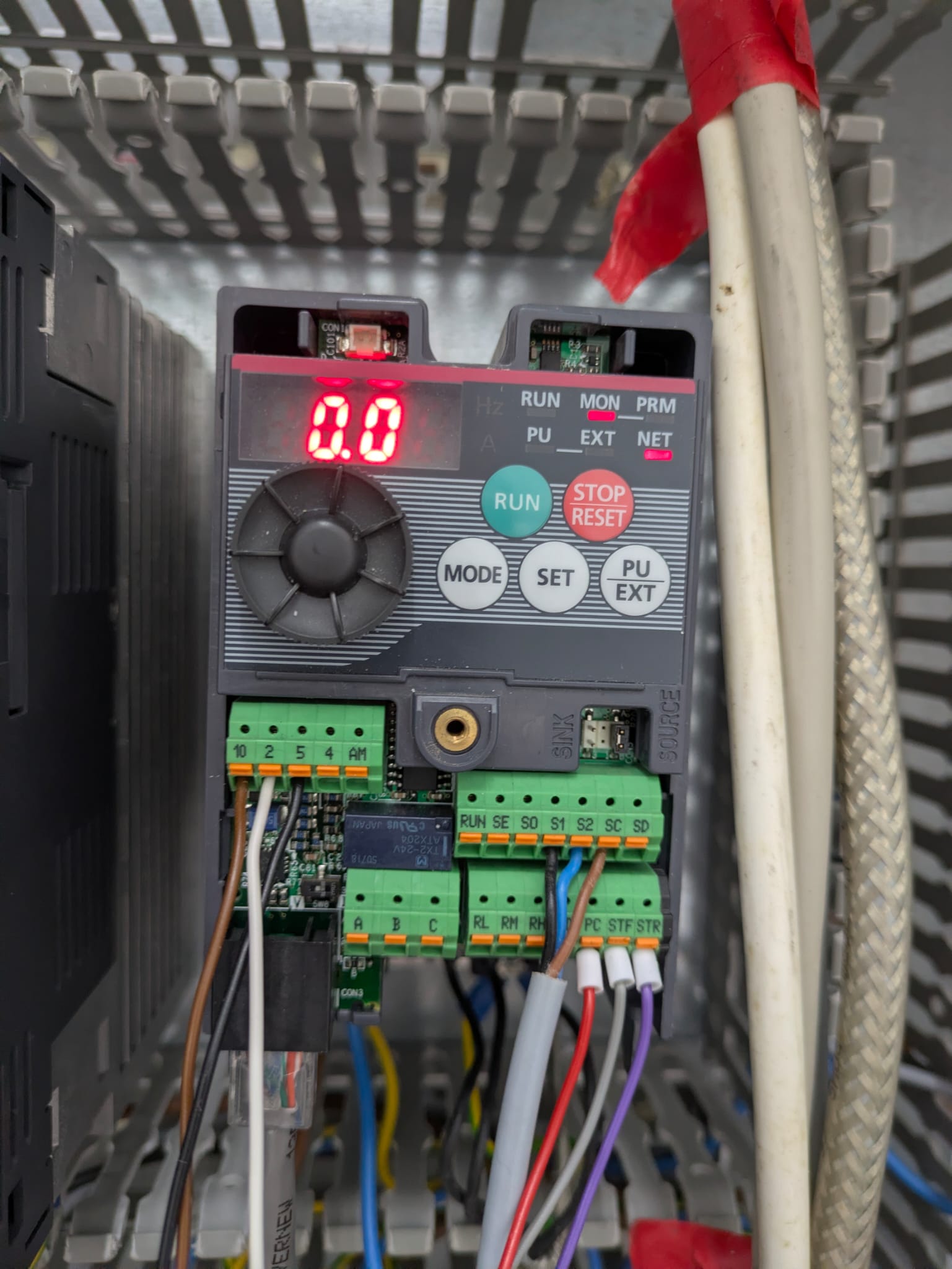
On the bottom left is an RJ-45 ethernet connector. This connector doesn’t provide Ethernet but gives the MODBUS-RTU link.
The other end of the ethernet cable should be cut and connected to the RS-485 to USB adapter. (see photo)
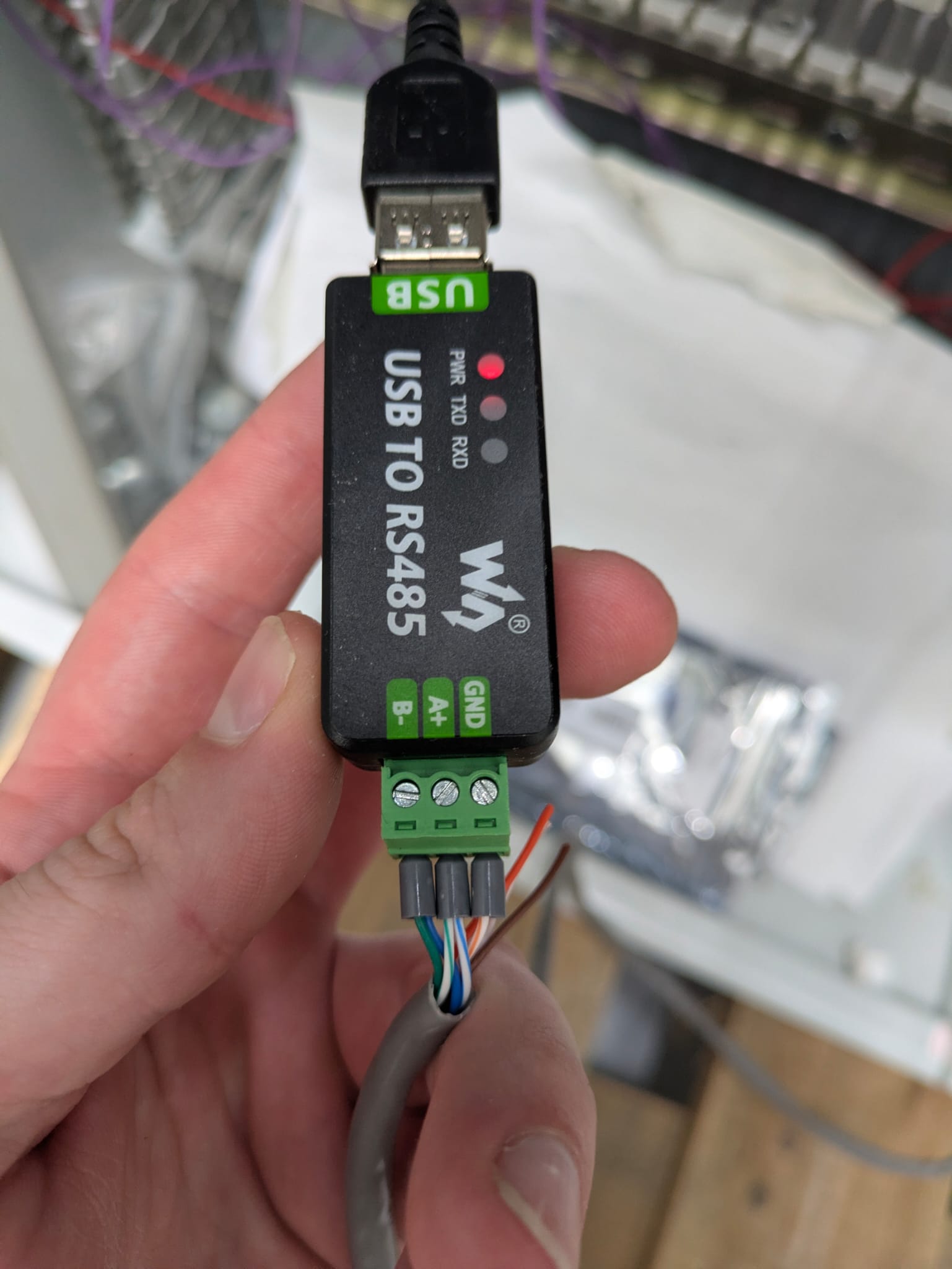
The following cables need to be connected to the following:
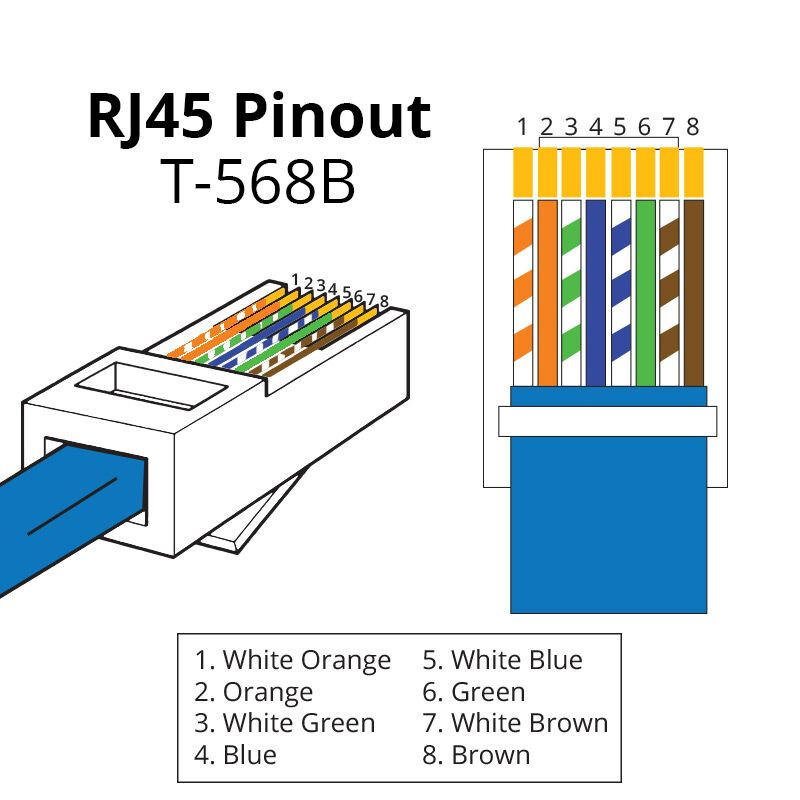
(Coloring isn’t always the same for every Ethernet cable.)
| wiring | usb adapter |
|---|---|
| 3 + 5 | A+ |
| 4 + 6 | B - |
| 1 | GND |
Setup
When you’ve wired the MODBUS-RTU adapter, you need to tell the inverter that you want to control it using MODBUS instead of manual control.
You’ll need to change the following settings on the inverter:
| Setting | Name | Value | Description |
|---|---|---|---|
| 79 | Operation mode selection | 0 | Allow NET mode on power-up; 0 lets you switch |
| 340 | Communication startup mode | 1 | Boot in NET (MODBUS) mode automatically |
| 549 | Protocol selection | 1 | MODBUS RTU (default is Mitsubishi protocol) |
| 117 | Station number | 1 | Slave address (change if you have multiple devices on the same MODBUS bus) |
| 118 | Communication speed | 192 | 19200 baud rate (also: 48, 96, 384) |
| 119 | Stop bit / data length | 10 | 8 data bits, 1 stop bit |
| 120 | Parity check | 2 | Even parity (Modbus standard) |
| 122 | Comm. check time interval | 9999 | Disabled timeout (won’t error on lack of communication) |
| 123 | Waiting time setting | 9999 | Use protocol default |
| 124 | CR/LF selection | 0 | Not used by Modbus, leave 0 |
| 1 | Maximum frequency | ? Hz | See attached motor (or leave as is) |
| 2 | Minimum frequency | 0.0 Hz | |
| 7 | Acceleration time | 2.0 s | Can make faster or slower if needed |
| 8 | Deceleration time | 2.0 s | Can make faster or slower if needed |
| 37 | Rotation speed setting | ? rpm | Max speed of the motor (see motor or leave as is) |
| 77 | Parameter write selection | 2 | Allows setting writes while the system is running. (easy for testing) |
After setting all the settings, you’ll need to power cycle the inverter for at least 30 seconds.
Software
When it is connected, you’ll need to check what COM port Windows has created. Then you can run the test script to test if it works. The script will run the conveyor belt 10 sec forward and then 10 seconds in reverse.
For this script you’ll need to install the serial package.
"""
Mitsubishi FR-D720S Modbus RTU control example - looping/repeatability version.

Each cycle:
  1. Run forward at 10 % of Pr.1 for RUN_TIME_S seconds
  2. Stop and ramp down
  3. Run reverse at 10 % for RUN_TIME_S seconds
  4. Stop and ramp down
  5. Print per-cycle and cumulative revolution totals

Keyboard control (Linux/macOS terminal):
  p   pause / resume    (motor is stopped while paused)
  q   quit cleanly      (motor stopped, final stats printed)
  Ctrl-C also exits cleanly.

Robustness: every Modbus call is wrapped in _with_retry() to survive the
EMI bursts coming out of the inverter's switching stage. See earlier notes
on shielding / ferrite / cable routing.

FR-D700 Modbus holding register map:
  40002  Inverter RESET           (writing here reboots the drive!)
  40009  Run command              bit0 STOP, bit1 STF, bit2 STR
  40014  Set frequency (RAM)      0.01 Hz
  40201  Output frequency         0.01 Hz
  40208  Output speed (rpm)       needs Pr.37 = rated rpm @ 50 Hz
"""

import sys
import time
import select
import termios
import tty
import minimalmodbus
import serial

# ---------------------------------------------------------------------------
# User configuration
# ---------------------------------------------------------------------------
PORT          = "/dev/ttyUSB1"
SLAVE_ADDR    = 1
BAUDRATE      = 19200
PARITY        = serial.PARITY_EVEN
BYTESIZE      = 8
STOPBITS      = 1
TIMEOUT_S     = 0.4

MAX_FREQ_HZ   = 120 #50.0
SPEED_PCT     = 10
RUN_TIME_S    = 5.0
POLL_PERIOD_S = 0.2

INTER_TX_S    = 0.02
MAX_RETRIES   = 3

MOTOR_POLES   = 4

# ---------------------------------------------------------------------------
# Register addresses (minimalmodbus uses 0-based: 4xxxx - 40001)
# ---------------------------------------------------------------------------
REG_RESET      = 40002 - 40001
REG_CONTROL    = 40009 - 40001
REG_SET_FREQ   = 40014 - 40001
REG_OUT_FREQ   = 40201 - 40001
REG_OUT_RPM    = 40208 - 40001

CTRL_STOP = 0x0001
CTRL_STF  = 0x0002
CTRL_STR  = 0x0004


# ---------------------------------------------------------------------------
# Non-blocking keyboard input
# ---------------------------------------------------------------------------
class KeyListener:
    """Put stdin in cbreak mode so we can poll for single keystrokes."""

    def __enter__(self):
        self.fd = sys.stdin.fileno()
        self.old = termios.tcgetattr(self.fd)
        tty.setcbreak(self.fd)
        return self

    def __exit__(self, *exc):
        termios.tcsetattr(self.fd, termios.TCSADRAIN, self.old)

    def get_key(self):
        """Return a single character if one is waiting, else ''."""
        dr, _, _ = select.select([sys.stdin], [], [], 0)
        if dr:
            return sys.stdin.read(1)
        return ''


# ---------------------------------------------------------------------------
# Robust Modbus wrapper
# ---------------------------------------------------------------------------
class CommStats:
    ok = 0
    retried = 0
    failed = 0


def _with_retry(inv, func, *args, **kwargs):
    last_exc = None
    for attempt in range(1, MAX_RETRIES + 1):
        try:
            result = func(*args, **kwargs)
            CommStats.ok += 1
            time.sleep(INTER_TX_S)
            return result
        except (minimalmodbus.NoResponseError,
                minimalmodbus.InvalidResponseError,
                minimalmodbus.LocalEchoError) as e:
            last_exc = e
            CommStats.retried += 1
            try:
                inv.serial.reset_input_buffer()
                inv.serial.reset_output_buffer()
            except Exception:
                pass
            time.sleep(0.05 * attempt)
    CommStats.failed += 1
    raise last_exc


# ---------------------------------------------------------------------------
def open_inverter() -> minimalmodbus.Instrument:
    inv = minimalmodbus.Instrument(PORT, SLAVE_ADDR, mode=minimalmodbus.MODE_RTU)
    inv.serial.baudrate = BAUDRATE
    inv.serial.parity   = PARITY
    inv.serial.bytesize = BYTESIZE
    inv.serial.stopbits = STOPBITS
    inv.serial.timeout  = TIMEOUT_S
    inv.clear_buffers_before_each_transaction = True
    time.sleep(0.2)
    return inv


def write_freq(inv, hz: float) -> None:
    value = int(round(hz * 100))
    _with_retry(inv, inv.write_register, REG_SET_FREQ, value, functioncode=6)


def set_control(inv, bits: int) -> None:
    _with_retry(inv, inv.write_register, REG_CONTROL, bits, functioncode=6)


def read_output_freq(inv) -> float:
    raw = _with_retry(inv, inv.read_register, REG_OUT_FREQ, functioncode=3)
    return raw / 100.0


def read_output_rpm(inv) -> int:
    return _with_retry(inv, inv.read_register, REG_OUT_RPM, functioncode=3)


# ---------------------------------------------------------------------------
# Control flow helpers
# ---------------------------------------------------------------------------
class QuitRequested(Exception):
    pass


def handle_keys(keys: KeyListener, inv) -> None:
    """
    Check stdin for 'p' (pause) or 'q' (quit).
    If paused, block here until 'p' (resume) or 'q' (quit).
    Motor is stopped on entry to pause, but the set-frequency is left intact.
    """
    k = keys.get_key()
    if not k:
        return
    if k.lower() == 'q':
        raise QuitRequested()
    if k.lower() == 'p':
        print("\n[PAUSED] motor stopped. Press 'p' to resume, 'q' to quit.")
        set_control(inv, CTRL_STOP)
        while True:
            k2 = keys.get_key()
            if k2.lower() == 'p':
                print("[RESUMED]")
                return
            if k2.lower() == 'q':
                raise QuitRequested()
            time.sleep(0.05)


def wait_until_stopped(inv, keys: KeyListener, t_prev_ref: list,
                       revs_accum_ref: list) -> None:
    """Spin until output frequency is essentially zero."""
    while True:
        time.sleep(POLL_PERIOD_S)
        handle_keys(keys, inv)
        t_now = time.monotonic()
        dt = t_now - t_prev_ref[0]
        t_prev_ref[0] = t_now
        try:
            f_out = read_output_freq(inv)
        except Exception:
            continue
        revs_accum_ref[0] += (f_out / (MOTOR_POLES / 2.0)) * dt
        if f_out < 0.05:
            return


def run_direction(inv, keys: KeyListener, direction_bits: int,
                  label: str, cycle: int) -> float:
    target_hz = MAX_FREQ_HZ * SPEED_PCT / 100.0
    print(f"\n--- cycle {cycle}: {label} at {SPEED_PCT}% ({target_hz:.2f} Hz) ---")

    set_control(inv, direction_bits)

    revs = [0.0]                # boxed so wait_until_stopped can mutate it
    t_start = time.monotonic()
    t_prev = [t_start]

    while True:
        time.sleep(POLL_PERIOD_S)
        handle_keys(keys, inv)
        t_now = time.monotonic()
        dt = t_now - t_prev[0]
        t_prev[0] = t_now

        try:
            f_out = read_output_freq(inv)
        except Exception as e:
            print(f"  [warn] read_output_freq failed: {e}")
            continue

        revs[0] += (f_out / (MOTOR_POLES / 2.0)) * dt

        try:
            rpm = read_output_rpm(inv)
        except Exception:
            rpm = -1

        print(f"  t={t_now - t_start:5.2f}s   f_out={f_out:5.2f} Hz   "
              f"rpm(reg)={rpm:5d}   est. revs={revs[0]:7.2f}")

        if t_now - t_start >= RUN_TIME_S:
            break

    set_control(inv, CTRL_STOP)
    print("  -> STOP, waiting for ramp-down")
    wait_until_stopped(inv, keys, t_prev, revs)

    print(f"  cycle {cycle} {label}: revolutions = {revs[0]:.2f}")
    return revs[0]


# ---------------------------------------------------------------------------
def main() -> None:
    inv = open_inverter()
    print(f"Connected to inverter at {PORT}, slave {SLAVE_ADDR}")
    print("Keys:  p = pause/resume,  q = quit")

    set_control(inv, CTRL_STOP)
    time.sleep(0.2)

    target_hz = MAX_FREQ_HZ * SPEED_PCT / 100.0
    write_freq(inv, target_hz)

    cycle = 0
    totals = {"fwd": 0.0, "rev": 0.0}
    per_cycle = []   # list of (cycle, fwd, rev, net)

    with KeyListener() as keys:
        try:
            while True:
                cycle += 1
                fwd = run_direction(inv, keys, CTRL_STF, "FORWARD", cycle)
                time.sleep(1.0)
                rev = run_direction(inv, keys, CTRL_STR, "REVERSE", cycle)

                totals["fwd"] += fwd
                totals["rev"] += rev
                per_cycle.append((cycle, fwd, rev, fwd - rev))

                print(f"\n=== cycle {cycle} summary ===")
                print(f"  fwd={fwd:7.2f}  rev={rev:7.2f}  net={fwd - rev:+7.2f}")
                print(f"  cumulative: fwd={totals['fwd']:8.2f}  "
                      f"rev={totals['rev']:8.2f}  "
                      f"net={totals['fwd'] - totals['rev']:+8.2f}")
                print(f"  comms: ok={CommStats.ok}  retried={CommStats.retried}  "
                      f"failed={CommStats.failed}")

                time.sleep(1.0)

        except (QuitRequested, KeyboardInterrupt):
            print("\n[QUIT] stopping motor...")
        finally:
            try:
                set_control(inv, CTRL_STOP)
            except Exception:
                pass

    # Final report
    print("\n=============== FINAL REPORT ===============")
    print(f"Cycles completed: {len(per_cycle)}")
    print(f"{'cyc':>4} {'fwd':>9} {'rev':>9} {'net':>9}")
    for c, f, r, n in per_cycle:
        print(f"{c:>4} {f:>9.2f} {r:>9.2f} {n:>+9.2f}")
    if per_cycle:
        fwds = [f for _, f, _, _ in per_cycle]
        revs = [r for _, _, r, _ in per_cycle]
        nets = [n for _, _, _, n in per_cycle]

        def stats(name, xs):
            mean = sum(xs) / len(xs)
            spread = max(xs) - min(xs)
            # population stddev
            var = sum((x - mean) ** 2 for x in xs) / len(xs)
            sd = var ** 0.5
            print(f"  {name}: mean={mean:8.2f}  min={min(xs):8.2f}  "
                  f"max={max(xs):8.2f}  spread={spread:6.2f}  sd={sd:6.3f}")

        print("\nRepeatability:")
        stats("fwd", fwds)
        stats("rev", revs)
        stats("net", nets)

    print(f"\nComms totals: ok={CommStats.ok}  "
          f"retried={CommStats.retried}  failed={CommStats.failed}")


if __name__ == "__main__":
    main()
NOTE: The starting of the motor can give interference with the MODBUS communication. The example script handles this with retries.
Handy info
Registers
| Register | Function | Units | R/W |
|---|---|---|---|
| 40201 | Output frequency | 0.01 Hz | R |
| 40202 | Output current | 0.01 A | R |
| 40203 | Output Voltage | 0.1 V | R |
| 40205 | Frequency setting | 0.01 Hz | R |
| 40208 | Converter output voltage (DC-bus) | 0.1 V | R |
| 40002 | Inverter reset | bool | W |
| 40009 | Run command (STF/STR/STOP bits) | 0 - 2 | W |
| 40014 | Set frequency (RAM) | 0.01 Hz | W |
| 40015 | Set frequency (EEPROM) (can only be done so many times) | 0.01 Hz | W |