Based on contributions by 21142173, How-to, Isai.dc.
Suction cups are a common end-effector choice: cheap, easy to control, and able to grip a wide range of materials using vacuum. This covers the components you need, how to pick the right suction cup and ejector, and how to handle objects that are prone to leaking (irregular surfaces, flimsy packaging).
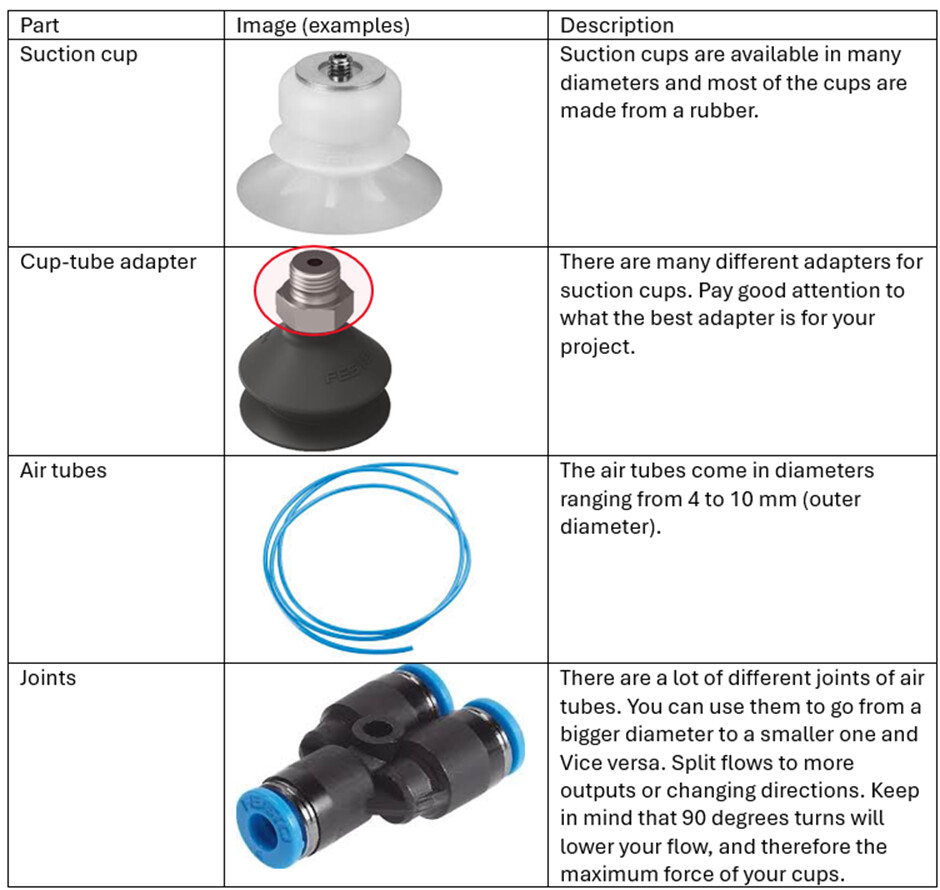
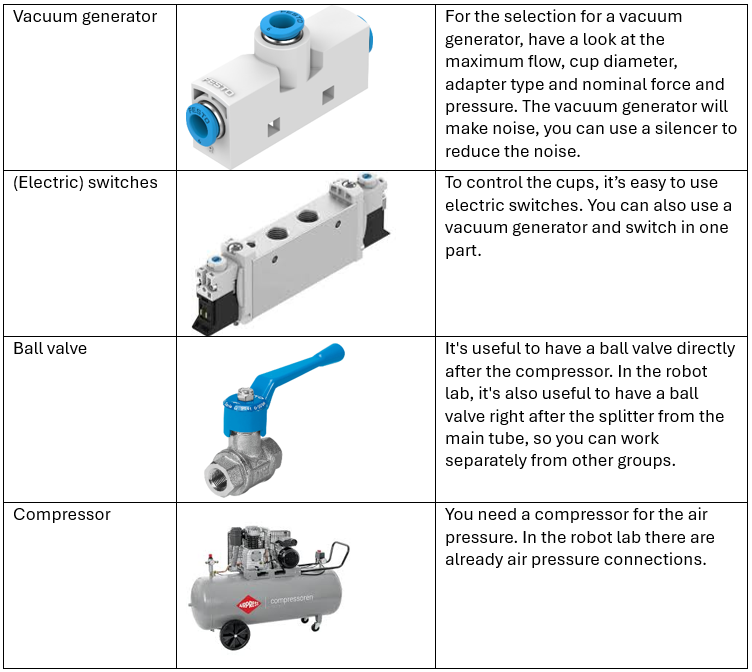
What you need
- Suction cup(s), sized for your object
- Vacuum ejector(s) (e.g. a low-flow or high-flow venturi ejector)
- Tubing — use the same diameter throughout your circuit
- A vacuum generator/valve (with an optional silencer to reduce noise)
- Compressor / compressed air supply
Festo has a complete assortment of suction cup system components, but check delivery times — other suppliers are often faster.
Pros and cons
Pros
- Grip a wide range of materials.
- Easy to control — just simple valves.
- Cheap compared to other gripping techniques, with low maintenance cost.
Cons
- Need a smooth, sealed surface — any leakage around the cup’s edge prevents a vacuum from forming.
- Vacuum generator valves are noisy (fit a silencer to reduce this).
- Require a compressed-air supply.
Steps
1. Choose the right suction cup
Factors that matter when selecting a cup:
- Size — bigger contact area gives more lifting force (
F = p × A), but must still fit your object. - Overarching angle / bellows — a bellows cup flexes to follow an uneven or angled surface; a flat cup needs a flat, consistent surface.
- Suction force — check it’s rated for the object’s weight, with margin.
Practical ways to check you’ve picked the right one:
- Test with your hand: attach the cup to an ejector, hold it in your hand, and try lifting the object.
- Remember a robot mount ≠ your hand: a robot picking up the object with a suction cup doesn’t behave exactly like you holding the same cup by hand.
- Test with the actual robot mount: simulates the approach movement the robot needs to make to get a good seal.
- Less is more: multiple suction cups can work against each other, especially on a flimsy surface where all cups need a seal simultaneously to hold vacuum.
- Use a calculator if you don’t have cups to test with, e.g. Schmalz’s suction cup calculator.
- Ask around: minor supervisors, teachers, suction cup companies (Schmalz, Festo), or the company you’re doing your minor at can advise, and can often provide sample cups to test with.
2. Choose the right ejector
Decide whether you need high flow or high vacuum, and what venturi diameter you need:
- High flow ejectors pull air out faster — needed if your seal is imperfect or you’re compensating for a small leak.
- High vacuum ejectors reach a stronger vacuum, useful once you already have a good seal and need more holding force.
A good match here reduces the time needed to form the seal and keeps the vacuum stable.
If you’re running a pneumatic tube longer than 2 metres, take the extra length into account when sizing the ejector — longer tubing increases the time (and flow) needed to pull a vacuum.
3. Picking up objects with an inconsistent or leak-prone surface
A simple flat object is easy: bring a suction cup into contact, let the ejector create suction, and it holds with little further effort from the ejector.
An object without a consistent, sealed surface — for example, a 1 kg flimsy plastic bag containing 300 small ceramic parts, prone to small holes — is harder. A normal single suction cup can’t form a good enough seal to hold negative pressure.
- Choose a suction cup that can deform around the object slightly to improve the seal.
- If the object is likely to develop small holes/leaks, use multiple suction cups so that at least one maintains a seal even if others don’t.
- If you know the object is leak-prone, consider a high-flow ejector to compensate, or size at least one of the multiple cups so it can hold the object’s full weight by itself.
4. Wire multiple suction cups correctly
Give each suction cup its own ejector. Do not share one ejector between multiple suction cups.
If several cups share one ejector, all of them need a good seal before any of them can pick up the object — and if just one cup loses its seal, it acts as a leak for all the others sharing that ejector, and the whole group fails to hold vacuum.
Troubleshooting
- Object won’t lift, no vacuum forms: check for leaks around the cup’s edge — surface isn’t flat/smooth enough, or the cup size/shape doesn’t match the object.
- Some cups hold, others don’t, on a multi-cup setup: you’re likely sharing one ejector across multiple cups — give each cup its own ejector.
- Weak vacuum with long tubing: confirm the ejector is sized for the tube length (>2 m) and that all tubing is the same diameter.
Related
- How to design and 3D-print a custom suction cup for a specific object — designing and 3D-printing a custom suction cup for a specific object
- How to set up a Festo vacuum sensor (SPAE, part 8001443) for suction cup feedback — adding a vacuum sensor for grip feedback
- How to control a Festo solenoid valve (VUVG-LK10-M52) from a UR robot — controlling the solenoid valve that switches the vacuum on/off
- Choosing between pneumatic and electric actuators — pneumatic vs. electric actuators, if you’re still deciding on a gripping approach
Rewritten and consolidated (Sept 2026) from the original student how-to’s: How to use suction cups, Select a suction cup for an end effector, How to use multiple leakage prone suction cups for picking up an object?.